Last updated on August 19th, 2026 at 04:19 pm
Living in a small home doesn’t mean you can’t give your guinea pigs a spacious and enriching habitat.
With a bit of creativity, you can design an enclosure that fits your space while meeting all their needs.
Here are 10 setup ideas that maximize every square inch without compromising on comfort or safety.
Vertical Loft Cage with Ramp
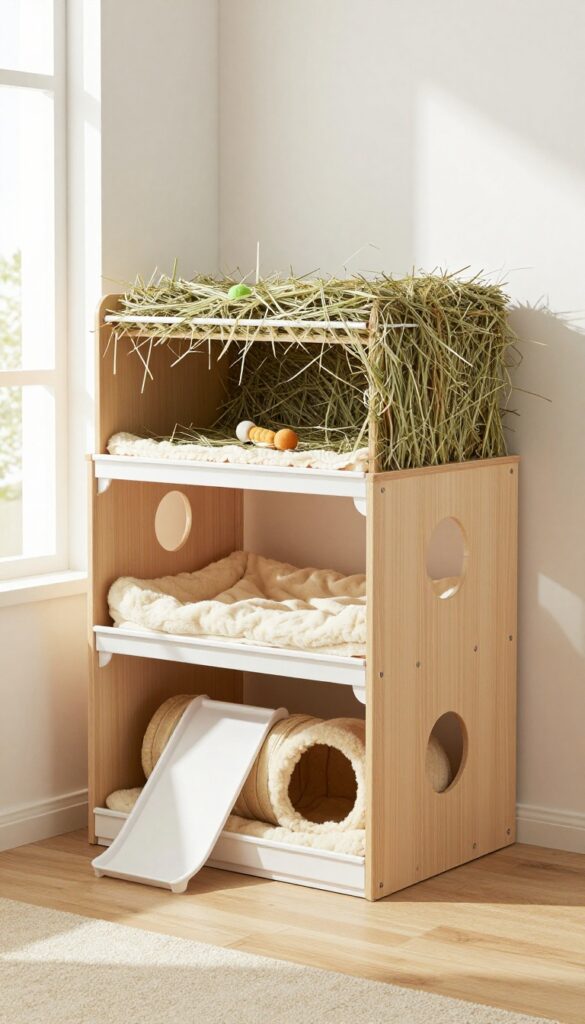
A vertical loft cage is a smart solution for small spaces, stacking levels to give your guinea pigs ample room without taking up extra floor area. This design typically includes a lower level for active play and an upper loft for sleeping or eating, connected by a gentle ramp.
When choosing a loft cage, prioritize solid flooring on both levels to protect guinea pigs’ feet. Wire floors can cause injury, so look for cages with plastic or metal trays. The ramp should have a gentle slope—no steeper than 45 degrees—and include side rails or textured steps for easy climbing.
Ensure the total floor space meets the minimum of 7.5 square feet per pair of guinea pigs, with the loft counted only if it is fully accessible.
Key features to look for
- Solid flooring on all levels to prevent foot injuries
- Ramp with a gentle slope and side guards for safety
- Separate areas: a cozy sleeping loft and a spacious play level
- Easy access for cleaning, such as front-opening doors or removable trays
- Adequate ventilation with mesh or bar sides
Set up the loft with soft fleece or paper bedding, a hideout for privacy, and a hay rack near the sleeping area. Place water bottles and food bowls on the lower level to encourage movement. Add chew toys and tunnels for enrichment.
This vertical layout works well in corners or against walls, making it ideal for apartments or small rooms.
Under-Desk Cage Nook
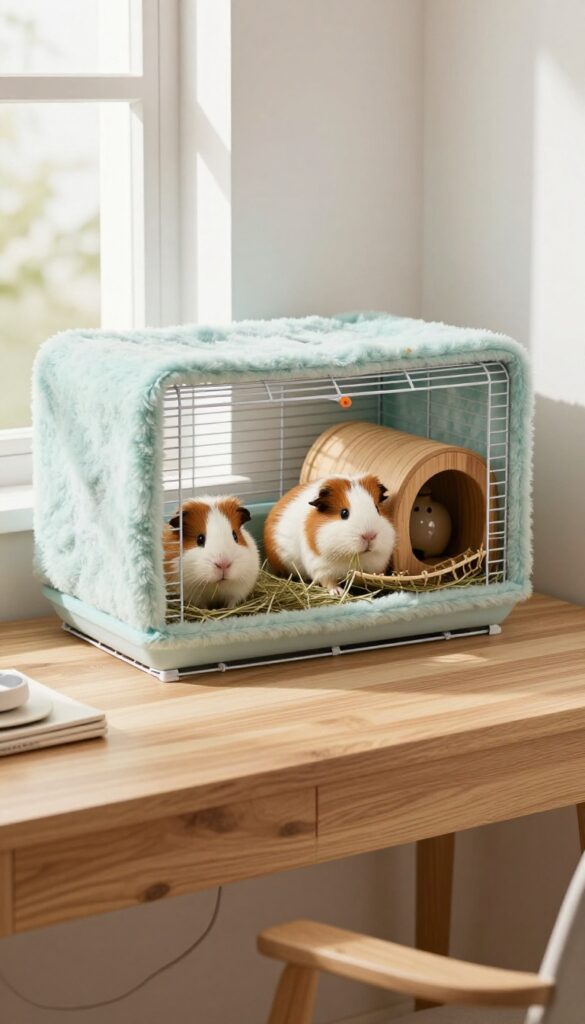
Make use of the empty space beneath your desk by placing a guinea pig cage there. This setup keeps your pets close while you work, without taking up extra floor space.
Choose a cage that fits snugly under your desk without blocking legroom. A standard C&C cage or a modular wire cage works well—just measure the height and depth of your desk opening first. Ensure the cage is fully enclosed or has high sides to prevent escapes and to protect your guinea pigs from any foot traffic nearby.
- Ventilation: Leave at least 2–3 inches of space between the cage top and the desk underside for airflow. Avoid placing anything on top of the cage that could block air movement.
- Cable protection: Use cable covers or cord organizers to keep wires out of reach. Guinea pigs love to chew, so secure all cables along the desk legs or use spiral wrap tubing.
- Flooring: Line the cage with fleece liners or paper-based bedding for easy cleaning. Place a shallow litter tray in one corner to simplify daily maintenance.
- Enrichment: Add hideouts, tunnels, and a hay rack. A small wooden bridge or chew toys keep them entertained while you work.
- Access: Choose a cage with a front door or a removable top so you can reach in for cleaning and interaction without moving the desk.
Modular C&C Cage with Storage Grids
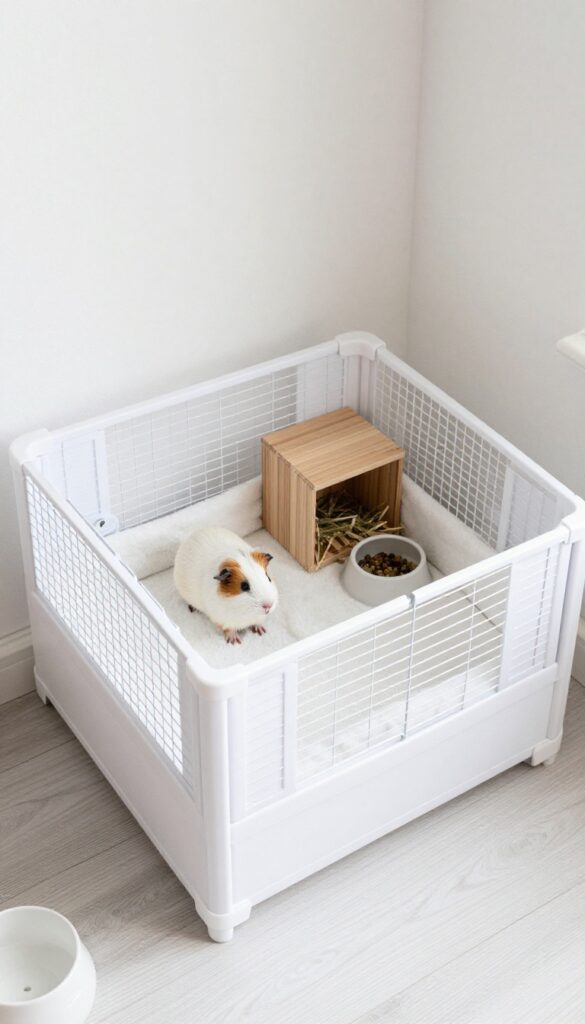
C&C (Cube and Coroplast) cages are a favorite among guinea pig owners because they are highly customizable and easy to fit into small spaces. Using storage grids as walls and a solid Coroplast base, you can create a cage that fits perfectly in a corner or under a desk.
The key to a successful C&C cage is the base: use a sheet of Coroplast (corrugated plastic) cut to size and folded up at the edges to create a solid, waterproof tray. This prevents urine leaks and makes cleaning easy. For the walls, standard storage cubes with a grid spacing of 1.5 inches or less are safe; larger gaps can allow guinea pigs to escape or get stuck.
Connect the grids securely with zip ties or connectors, and avoid using grids as flooring because they can hurt sensitive feet.
Setup Tips
- Choose a corner or alcove to maximize floor space without taking over the room.
- Line the base with fleece liners or disposable bedding for easy cleanup.
- Add hideouts, a hay rack, a water bottle, and a food bowl to create a complete habitat.
- Leave a section of the cage open for cleaning access, or use a grid door that swings open.
This modular system allows you to expand or reconfigure the cage as needed, making it ideal for growing guinea pigs or changing room layouts. Always ensure the cage provides at least 7.5 square feet of floor space for one pig, and more for pairs.
Multi-Level Cage with Hideaway Tunnels
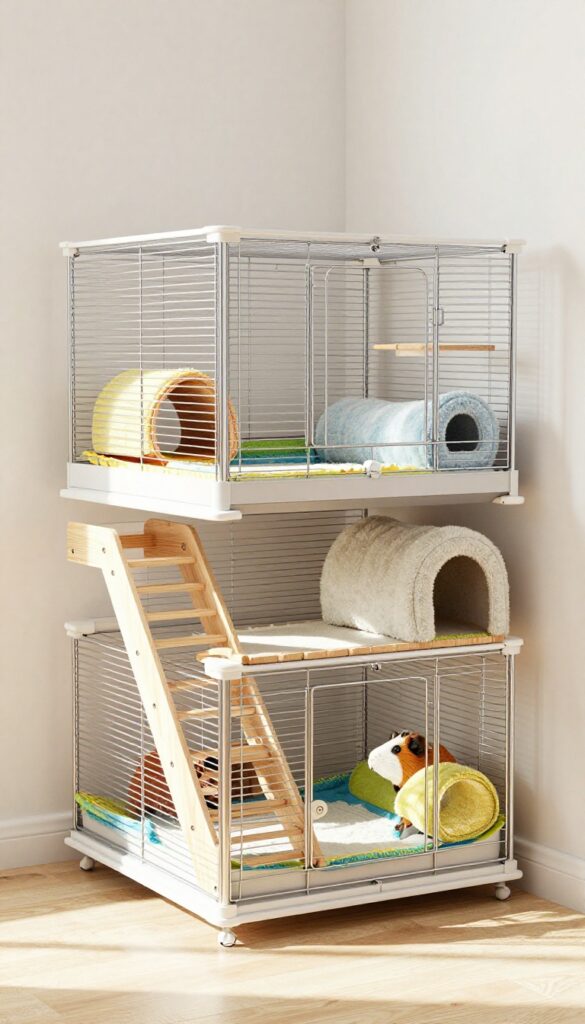
A multi-level cage with connecting tunnels is a fantastic way to add vertical space without taking up more floor area. Guinea pigs love to explore, and tunnels provide both exercise and a sense of security.
When setting up a multi-level cage, ensure each level is connected by a sturdy ramp or tunnel. The tunnel diameter should be at least 6 inches to allow easy passage for adult guinea pigs. Use rigid, chew-safe materials like PVC or reinforced fabric tunnels, and secure them firmly to prevent collapse.
Key Considerations
- Provide at least 7.5 square feet of floor space per guinea pig, distributed across levels.
- Use fleece liners or paper bedding on each level for comfort and easy cleaning.
- Place hideouts and hay racks on multiple levels to encourage exploration.
- Ensure water bottles and food bowls are accessible from each level.
- Include a solid floor area on each level to prevent foot injuries.
Cleaning access is crucial: choose a cage design with removable trays or large doors. Tunnels should be detachable for regular washing. Avoid tunnels that are too long or dark, as guinea pigs may feel trapped.
Instead, keep tunnels short (no more than 2 feet) and incorporate multiple entry points.
Corner Cage with Triangular Layout
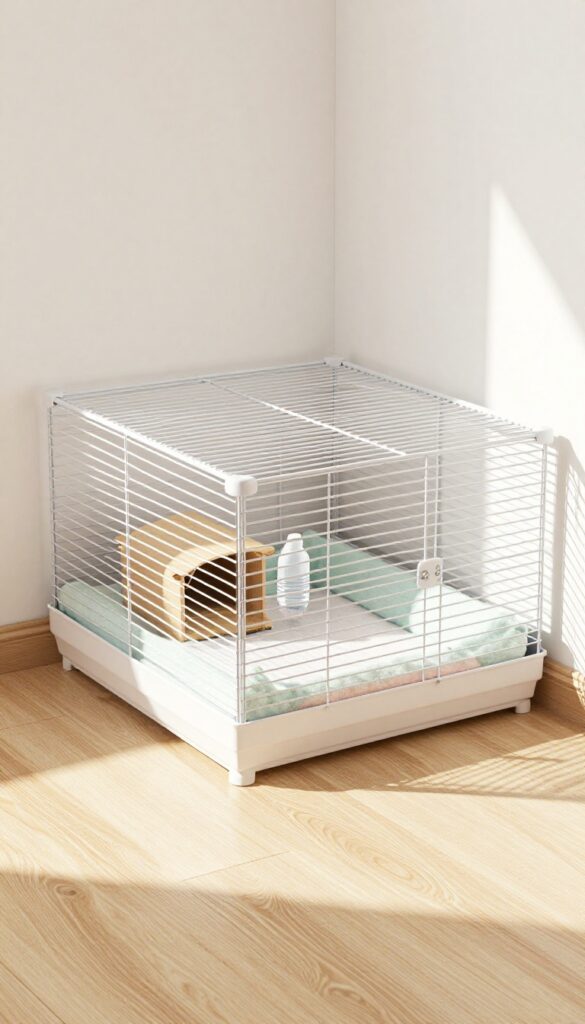
Corners are often wasted space in small homes, but with a triangular enclosure you can turn an unused corner into a spacious guinea pig habitat. This layout fits snugly into the room’s geometry, maximizing floor area without protruding into walkways.
A triangular cage can be built using C&C grids or custom wood panels. The angled shape naturally follows the corner, giving your guinea pigs more running room than a rectangular cage of the same footprint. For two guinea pigs, aim for at least 10.5 square feet of floor space; for three, 13 square feet.
The triangular design makes it easy to achieve these dimensions in a compact area.
Key Setup Tips
- Use smooth interior corners: cover any sharp grid ends with coroplast or fleece liners to prevent injury.
- Ensure adequate ventilation: if using wood sides, leave gaps or install mesh panels for airflow.
- Place bedding like fleece liners or paper-based bedding; avoid cedar or pine shavings.
- Add a hideout in the deepest part of the corner for security, and a hay rack on one side.
- Keep water bottles and food bowls accessible from the front for easy refilling.
Because the cage is tucked away, it stays out of high-traffic areas, reducing stress for your pigs. The triangular layout also creates natural zones: a sleeping area in the back, a play area in the center, and a feeding area near the entrance. Cleanup is straightforward since the shape allows you to reach all corners without stretching.
Stackable Cage System for Multiple Pigs
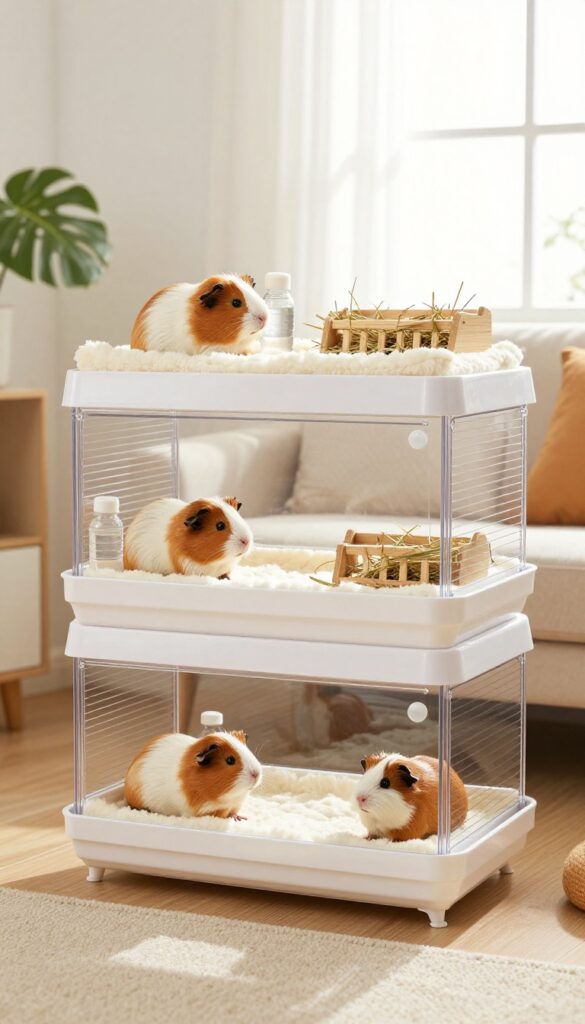
If you have more than one guinea pig but limited floor space, a stackable cage system lets you house them separately or together in a vertical footprint. Each level functions as its own enclosure, so you can keep pigs in pairs or groups while using the same floor area as a single cage.
These systems typically come as modular units that you can stack two or three high. The key is to choose cages with solid, leak-proof floors between levels to prevent waste and urine from dripping onto the pigs below. Each level should have a minimum height of 12 inches so guinea pigs can stand upright, and the overall structure must be stable and secured with locking clips or brackets.
Key Setup Tips
- Use solid plastic or coated metal trays between levels—never wire flooring, which can injure guinea pig feet.
- Ensure each level has its own access door for easy cleaning and interaction.
- If connecting levels with ramps, make sure ramps are wide and have side guards to prevent falls.
- Provide separate hideouts, hay, water bottles, and food bowls per level to avoid competition.
- Check that the bottom level has good ventilation; stackable cages can trap heat if airflow is poor.
A stackable system is ideal for small homes because it uses vertical space efficiently. For example, a two-level cage with a 2×4-foot footprint gives you 8 square feet of floor space total, enough for a pair of guinea pigs per level. Just be careful not to overcrowd—each pig needs at least 7.5 square feet of space.
With proper bedding, fleece liners, and regular cleaning, a stackable setup can keep multiple guinea pigs happy and healthy in a compact area.
Cage on Wheels for Flexible Placement
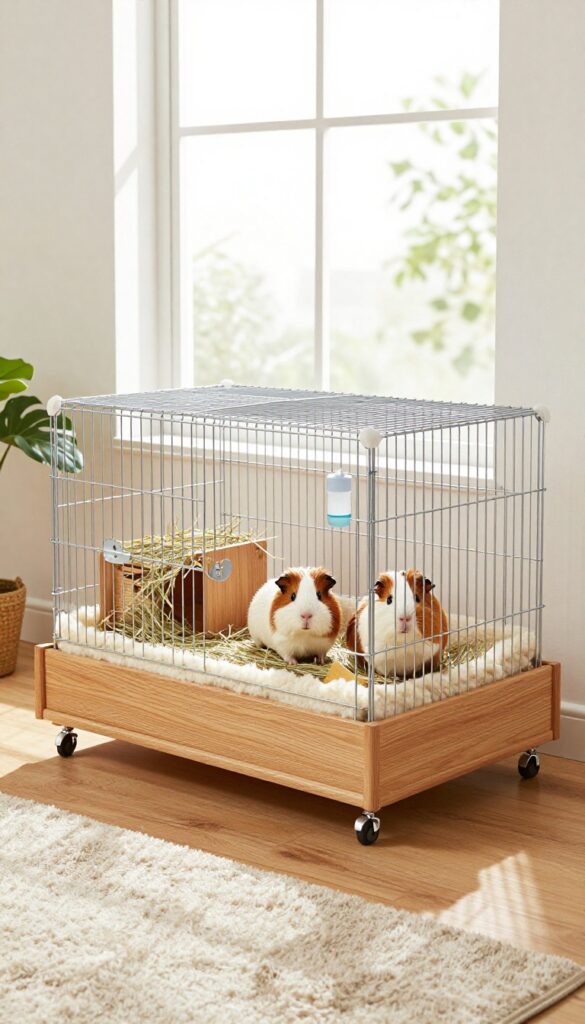
A cage on lockable casters gives you the freedom to reposition your guinea pig habitat as needed—whether for cleaning, adjusting sunlight exposure, or rearranging your room. This setup is especially valuable in small homes where every square foot counts.
When choosing a cage on wheels, focus on stability and safety. The base must be sturdy enough to support the full weight of bedding, hides, and your pigs without wobbling. Locking casters are essential: they keep the cage stationary during daily use and prevent accidental rolling when you bump into it.
Wheel quality matters. Smooth-rolling, large-diameter casters (at least 2 inches) glide over thresholds and floor transitions without jostling your guinea pigs. Avoid small, hard plastic wheels that can catch on carpet or debris.
Rubber or soft urethane wheels are quieter and gentler on floors.
Key considerations for a cage on wheels
- Locking casters rated for at least 50–100 lbs per caster, depending on cage size
- Smooth-rolling wheels (2–3 inch diameter) to avoid vibration
- Sturdy base—a solid wood or thick plastic platform prevents tipping
- Always lock wheels before cleaning or interacting with pigs
- Never move the cage with guinea pigs inside; transfer them to a safe carrier first
For a guinea pig enclosure, ensure the wheeled base supports standard cage dimensions (e.g., 2×4 C&C grids or a 40-inch-wide commercial cage). Add a deep fleece liner or bedding tray, a hay rack, a hideout, and a water bottle—all accessible even when the cage is rolled into a tight corner. Ventilation remains key: open bar sides or mesh panels are ideal.
With lockable wheels, you can roll the cage to a sunny spot for daytime and away from drafty windows at night.
Wall-Mounted Hutch with Floor Pen
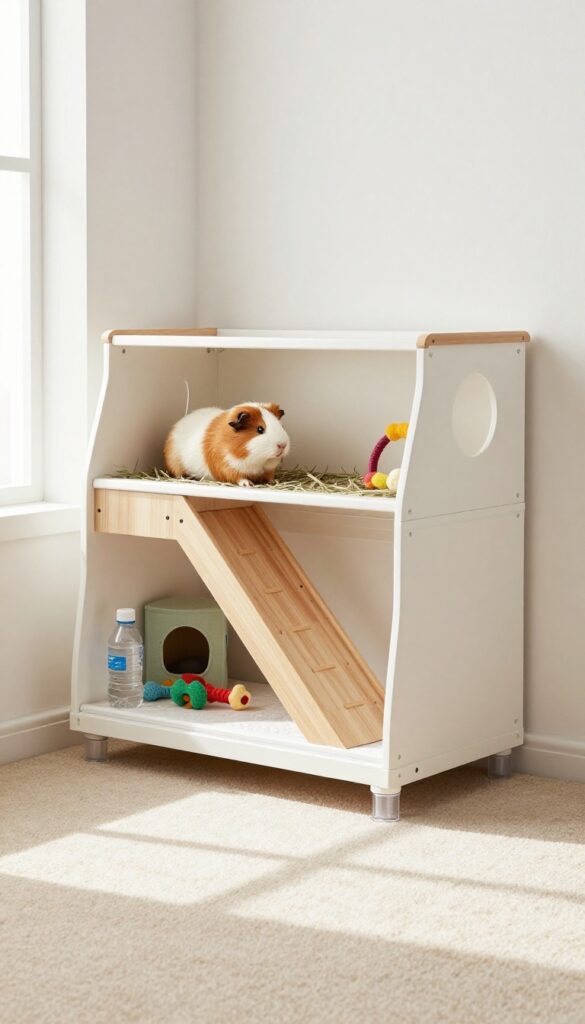
Combining a wall-mounted hutch with an attached floor pen is a brilliant way to maximize vertical space while still providing ample room for your guinea pigs to exercise. This setup keeps the sleeping and eating area off the floor, freeing up square footage, while the pen below offers a safe play zone.
The hutch should be securely mounted to wall studs to safely support the weight of the cage, bedding, and your guinea pigs. Choose a hutch with a solid bottom or a removable tray for easy cleaning. The attached floor pen should have a solid bottom (or be placed on low-pile carpet) to protect your piggies’ feet.
Ensure the pen is large enough—at least 7.5 square feet per pig—and includes hideouts, a hay rack, water bottle, and chew-safe toys.
Key considerations for this setup
- Mount the hutch at a height that allows easy access for cleaning and interaction, but low enough that guinea pigs can safely enter and exit via a ramp or opening.
- The floor pen should have a solid bottom or be placed on a low-pile carpet to prevent foot injuries.
- Provide a ramp or gentle incline between the hutch and pen so pigs can move freely.
- Include multiple hideouts, a hay rack, and a water bottle in both levels if space allows.
- Ensure good ventilation in the hutch and pen; avoid placing in direct sunlight or drafty areas.
Start with a Simple Setup
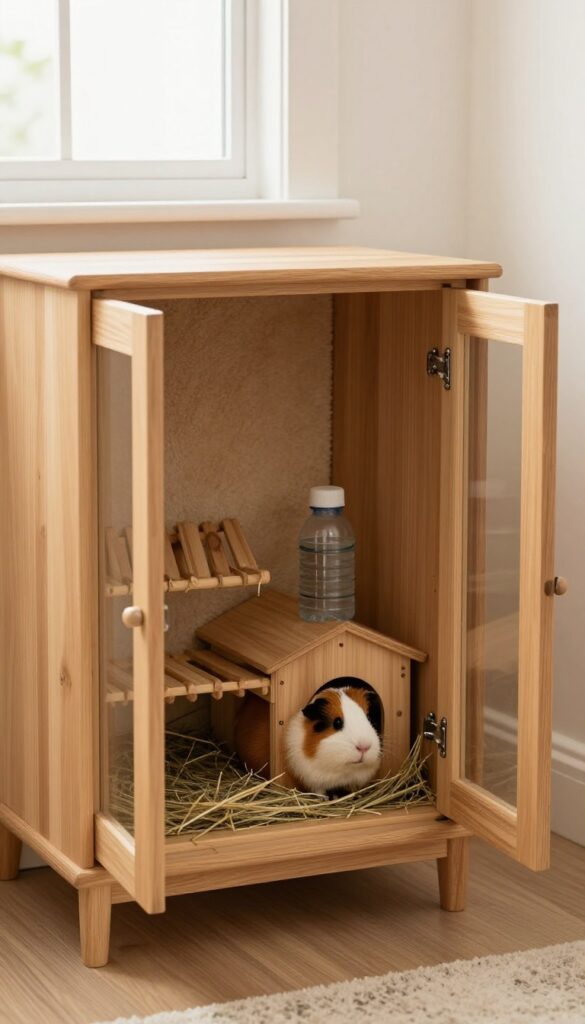
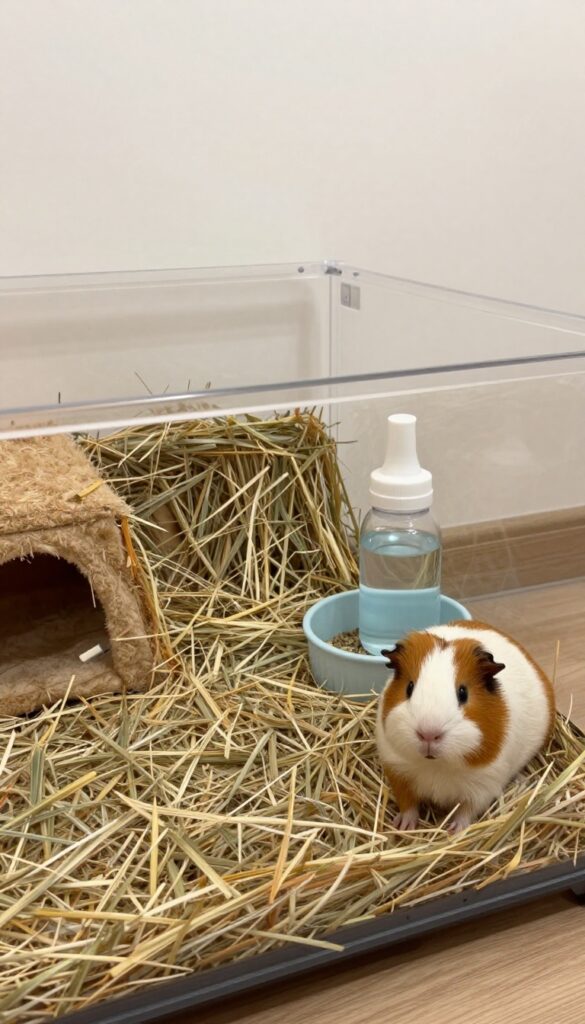
Not every guinea pig enclosure needs to be a complex DIY project. Starting with a simple, well-planned setup can be just as effective—especially when you want the cage to blend seamlessly into a small home. One clever approach is to house the cage inside a cabinet or sideboard, turning it into a piece of furniture that also serves as a safe, comfortable habitat.
Choose a cabinet that is wide and deep enough to accommodate at least 7.5 square feet of floor space (the minimum for one guinea pig, but more is better). The cabinet should have doors that open fully for easy access and ventilation. When the doors are closed, ensure there is adequate airflow—either through gaps, mesh panels, or by leaving the doors slightly ajar.
Use only non-toxic paint or finish on the cabinet interior to prevent harm if your guinea pig chews on the wood.
- Line the cabinet floor with a washable fleece liner or absorbent bedding for easy cleaning.
- Place a hay rack, water bottle, and food bowl in accessible spots, and add at least one hideout for security.
- Include chew-safe toys and tunnels to keep your guinea pig entertained.
- Make sure the interior surfaces are easy to wipe down—smooth, sealed wood or a removable tray works best.
This setup works well in a living room or home office, as the cabinet hides the cage while keeping your pet safe and comfortable. Just remember to open the doors daily for fresh air exchange and to interact with your guinea pig. With a simple, furniture-style enclosure, you can have a happy pet without sacrificing your home’s aesthetic.
Loft Bed Cage with Play Area Below
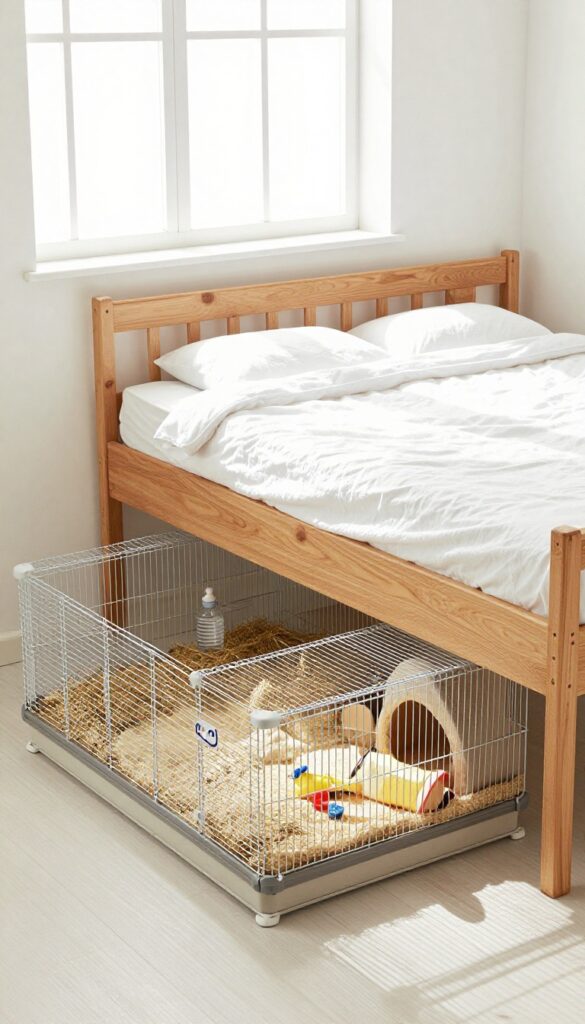
Maximize vertical space by placing your guinea pig’s cage under a loft bed, with an attached play area that extends beyond the bed’s footprint.
This setup works best when the loft bed is high enough to allow easy access to the cage—at least 30 inches of clearance. The cage itself should be a sturdy wire or C&C structure with a solid floor, lined with fleece or bedding. Place a hay rack, water bottle, and hideouts inside the cage.
Below, a fenced play area (using grid panels or a portable pen) gives your pigs extra roaming space. Ensure the bed frame is stable and that no objects can fall into the enclosure. Use a dust-free bedding and provide chew toys for enrichment.
The play area should have a soft floor (fleece or mats) and be easy to clean.
- Choose a loft bed with at least 30 inches of clearance for easy cage access.
- Use a C&C cage or large wire cage with a solid base to prevent debris from falling.
- Attach a playpen around the cage area using grid panels or a foldable pen.
- Secure all loose items above the cage to prevent accidents.
- Provide hideouts, tunnels, and chew toys in both cage and play area.
- Ensure good ventilation around the cage and avoid blocking air flow.
FAQ
What is the minimum cage size for two guinea pigs?
The minimum recommended size for two guinea pigs is 7.5 square feet (e.g., 30″ x 36″), but larger is always better. Many small-space setups can achieve this with vertical space or custom shapes.
Can guinea pigs live in a multi-level cage?
Yes, but ensure ramps are gentle (not too steep) and levels have solid flooring. Guinea pigs are not agile climbers, so each level should be easily accessible and safe.
How do I keep the cage from smelling in a small room?
Use absorbent bedding like fleece liners with an absorbent layer underneath, spot clean daily, and do full cleanings weekly. Good ventilation also helps reduce odors.
Is it safe to put a guinea pig cage under a desk?
Yes, as long as there is adequate airflow, the cage is fully enclosed or has high sides to prevent escape, and cables are protected from chewing.
Conclusion
With these 10 ideas, you can create a guinea pig enclosure that fits perfectly in your small home. Remember to prioritize floor space, safety, and enrichment.
Your pigs will thrive in a well-designed setup, no matter the size of your living area.

I’m Pallab Kishore, the owner of Little Pets Realm — an animal lover and pet care enthusiast sharing easy tips, healthy recipes, and honest advice to help every small pet live a happy, healthy, tail-wagging life.